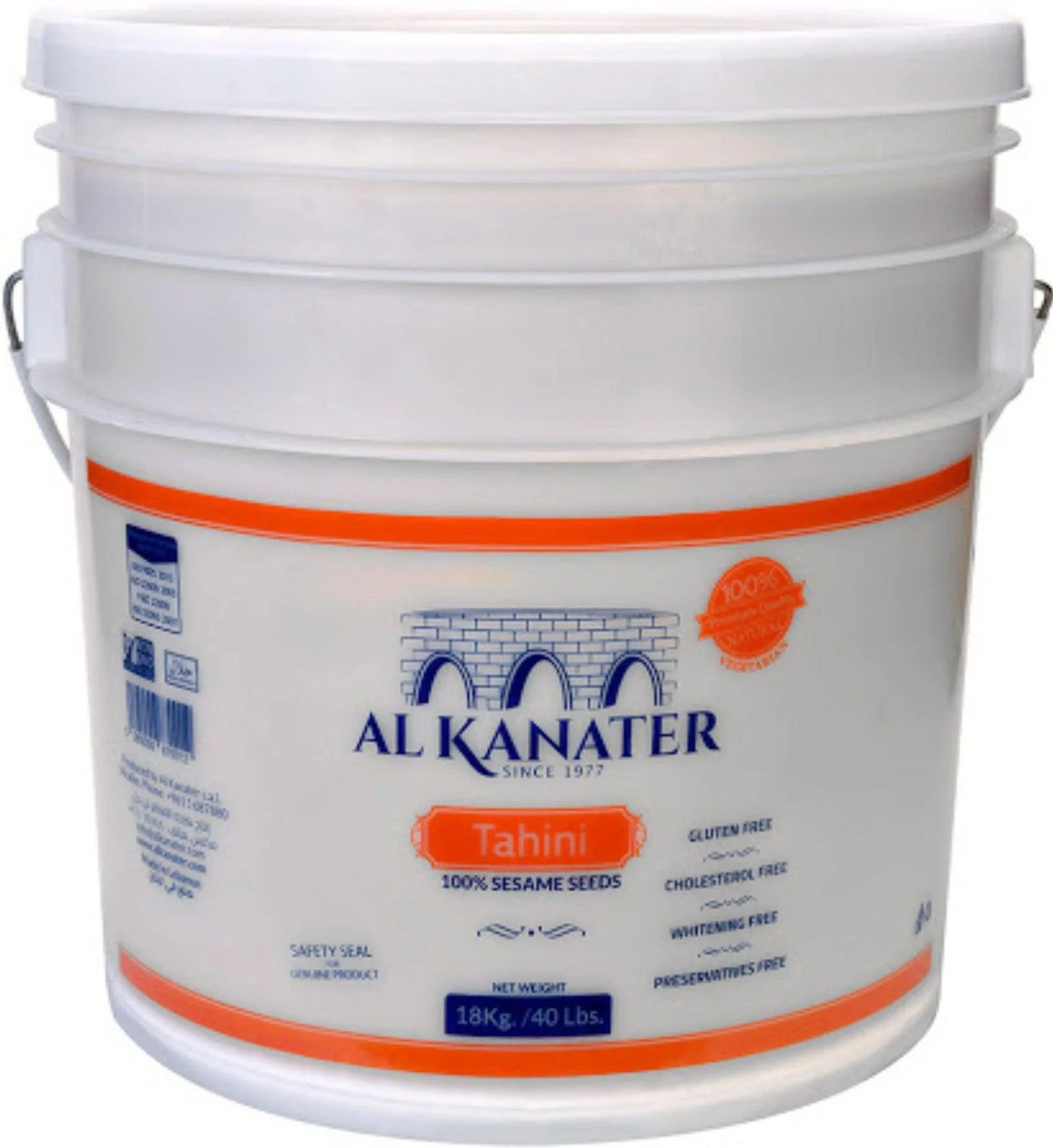
Al Kanater - Tahini
Al Kanater Tahini 18 kg Bucket in Bulk | Delivery Across GTA
Product Overview
Al Kanater Tahini is a sesame-based paste produced from ground sesame seeds, supplied in an 18 kg case format for commercial and wholesale buyers. Also referred to as tahina in Middle Eastern culinary traditions, this product is a foundational ingredient across a wide range of foodservice applications — from dips and dressings to baked goods and sauce bases.
Al Kanater is a recognised brand within the wholesale tahini and Middle Eastern ingredient supply sector, with distribution reaching foodservice operators, specialty retailers, and institutional kitchens across Canada. The 18 kg case format is suited to operations with consistent, high-volume tahini requirements.
What Is Tahini?
Tahini is a paste made from ground sesame seeds, available in hulled or unhulled forms depending on the production process. It has a smooth, pourable consistency and a rich, nutty flavour with a slight bitterness characteristic of sesame. Tahini is a staple ingredient in Middle Eastern, Mediterranean, and North African cuisines and has become widely integrated into contemporary foodservice menus globally.
In commercial kitchen applications, tahini functions as a base ingredient rather than a standalone condiment — it is typically combined with other ingredients to produce finished sauces, dips, dressings, and marinades. It is also used in confectionery and baking applications where sesame flavour and fat content are relevant to the finished product.
Common Commercial Applications
Al Kanater Tahini is used across a broad range of professional food environments, including:
- Restaurants and commercial kitchens producing hummus, baba ganoush, tahini sauce, and other Middle Eastern or Mediterranean staples in large batches
- Catering companies requiring consistent, high-yield sesame paste for event-scale food production
- Cafés and quick-service restaurants incorporating tahini into dressings, grain bowls, wraps, and sandwich spreads
- Food trucks and carts specialising in shawarma, falafel, or globally inspired street food
- Bakeries and confectionery producers using tahini in halva, sesame cookies, pastry fillings, and specialty breads
- Specialty grocery retailers and delis stocking bulk tahini for portioning and resale, or for use in in-store prepared food programs
- Hotels and hospitality kitchens supporting Middle Eastern buffet programs or à la carte menu offerings
- Food manufacturers incorporating bulk tahini as a raw ingredient in packaged dips, sauces, and spreads
Product Characteristics
| Feature | Detail |
|---|---|
| Brand | Al Kanater |
| Product Type | Sesame paste (tahini / tahina) |
| Pack Format | Case |
| Net Weight | 18 kg |
| Base Ingredient | Ground sesame seeds |
| Consistency | Smooth, pourable paste |
| Distribution | Available for wholesale delivery across Canada |
The 18 kg case format reduces per-unit cost relative to smaller retail pack sizes and supports uninterrupted production in high-volume kitchens. As with most natural sesame pastes, some oil separation may occur during storage, which is a normal characteristic of the product and does not indicate spoilage.
Why Foodservice Operators Use Bulk Tahini
There are several practical reasons commercial operators source tahini in bulk case formats rather than smaller retail packaging:
- Volume efficiency — An 18 kg case supports extended production runs without frequent restocking
- Cost-per-unit reduction — Bulk wholesale formats generally carry a lower cost per kilogram compared to retail-packaged equivalents
- Consistent flavour baseline — Using a single-source branded tahini supports recipe standardisation across multiple service periods or locations
- Versatile ingredient application — One product usable across savoury and sweet applications reduces SKU complexity in storage
- Recognised brand within Middle Eastern foodservice supply — Al Kanater tahini is a known product in the wholesale tahini category, relevant for operators who source by brand specification
Preparation and Handling in Commercial Settings
Tahini in large-format cases is typically transferred into smaller containers for daily kitchen use. Before use, the paste should be stirred thoroughly to reincorporate any separated sesame oil, which naturally rises to the surface during storage — this is standard for natural sesame paste products.
Common preparation steps in commercial kitchens include:
- Hummus production — Blended with chickpeas, lemon juice, garlic, and olive oil in commercial batch quantities
- Tahini sauce — Thinned with water and lemon juice to produce a pourable dressing used widely in shawarma, falafel, and grain bowl service
- Salad dressings and marinades — Combined with citrus, vinegar, and spices for dressings with sesame character
- Baking and confectionery — Incorporated into cookie doughs, halva-style confections, and pastry fillings
- Dipping sauces — Mixed with herbs, chilli, or roasted garlic for table condiment programs
Opened cases should be stored in accordance with the manufacturer's storage guidelines, typically in a cool, dry environment, with individual containers sealed between uses to preserve freshness.
Bulk and Wholesale Buyer Considerations
For operations purchasing Al Kanater Tahini in wholesale quantities, the 18 kg case format supports cost-effective inventory planning for kitchens with regular sesame paste usage. Buyers should account for storage space and turnover rate when determining order volumes, as natural tahini has a defined shelf life that should be factored into procurement cycles.
Operations running multi-location programs or catering to large institutional accounts may benefit from establishing regular reorder schedules to maintain consistent stock levels. As with all edible oil-containing products, storage away from direct heat and light is recommended to maintain product quality through to end use.
Al Kanater Tahini in the wholesale 18 kg case format is available for delivery across Canada.
Frequently Asked Questions (FAQs)
Q: What is the difference between tahini and tahina?
A: Tahini and tahina refer to the same product — a paste made from ground sesame seeds. "Tahini" is the more commonly used term in English-language foodservice and retail contexts, while "tahina" is the traditional Arabic pronunciation and spelling. Both terms are used interchangeably across commercial supply channels.
Q: Is oil separation in bulk tahini normal?
A: Yes. Natural sesame paste will separate over time, with the sesame oil rising to the surface of the container. This is a standard characteristic of tahini that has not been heavily processed or stabilised with additives. Thorough stirring before use reincorporates the oil and restores the paste to its intended consistency.
Q: How should an 18 kg case of tahini be stored in a commercial kitchen?
A: Unopened cases should be stored in a cool, dry location away from direct heat and sunlight. Once opened, individual containers should be sealed and stored according to the manufacturer's recommendations. Some operators refrigerate opened tahini to extend shelf life, though this can thicken the paste and may require tempering before use.
Q: Can Al Kanater Tahini be used in both savoury and sweet applications?
A: Yes. Tahini is a versatile ingredient used in both savoury applications — such as hummus, sauces, and dressings — and sweet or baked applications such as halva, sesame cookies, and confectionery fillings. The specific formulation should be confirmed on the product label to ensure suitability for intended applications.
Q: Is bulk tahini suitable for large-batch hummus production?
A: Tahini is a primary ingredient in hummus and is commonly sourced in bulk case formats specifically for large-batch hummus production in commercial kitchens, catering operations, and food manufacturing facilities. The 18 kg case format supports high-volume production runs without the inefficiency of working with multiple smaller containers.
Q: What allergen considerations apply to tahini in a commercial setting?
A: Sesame is a recognised major allergen in Canada and must be declared on finished food product labels when tahini or sesame paste is used as an ingredient. Foodservice operators and food manufacturers should review the product's allergen information on packaging and ensure appropriate disclosure in menus and product labelling in accordance with applicable food labelling requirements.
Q: How does the 18 kg wholesale case compare to retail tahini packaging?
A: The 18 kg case format is significantly larger than retail-packaged tahini, which is typically sold in units ranging from 250 g to 1 kg. The wholesale case format reduces per-unit cost and packaging waste for high-volume users and is designed for commercial and institutional purchasing rather than consumer use.
Q: Is Al Kanater Tahini available for delivery outside of major urban centres in Canada?
A: Al Kanater Tahini in the wholesale case format is available for delivery across Canada. Buyers outside major metropolitan areas are encouraged to confirm delivery logistics, lead times, and minimum order requirements when placing wholesale orders
Al Kanater Tahini 18 kg Bucket in Bulk | Delivery Across GTA
Product Overview
Al Kanater Tahini is a sesame-based paste produced from ground sesame seeds, supplied in an 18 kg case format for commercial and wholesale buyers. Also referred to as tahina in Middle Eastern culinary traditions, this product is a foundational ingredient across a wide range of foodservice applications — from dips and dressings to baked goods and sauce bases.
Al Kanater is a recognised brand within the wholesale tahini and Middle Eastern ingredient supply sector, with distribution reaching foodservice operators, specialty retailers, and institutional kitchens across Canada. The 18 kg case format is suited to operations with consistent, high-volume tahini requirements.
What Is Tahini?
Tahini is a paste made from ground sesame seeds, available in hulled or unhulled forms depending on the production process. It has a smooth, pourable consistency and a rich, nutty flavour with a slight bitterness characteristic of sesame. Tahini is a staple ingredient in Middle Eastern, Mediterranean, and North African cuisines and has become widely integrated into contemporary foodservice menus globally.
In commercial kitchen applications, tahini functions as a base ingredient rather than a standalone condiment — it is typically combined with other ingredients to produce finished sauces, dips, dressings, and marinades. It is also used in confectionery and baking applications where sesame flavour and fat content are relevant to the finished product.
Common Commercial Applications
Al Kanater Tahini is used across a broad range of professional food environments, including:
- Restaurants and commercial kitchens producing hummus, baba ganoush, tahini sauce, and other Middle Eastern or Mediterranean staples in large batches
- Catering companies requiring consistent, high-yield sesame paste for event-scale food production
- Cafés and quick-service restaurants incorporating tahini into dressings, grain bowls, wraps, and sandwich spreads
- Food trucks and carts specialising in shawarma, falafel, or globally inspired street food
- Bakeries and confectionery producers using tahini in halva, sesame cookies, pastry fillings, and specialty breads
- Specialty grocery retailers and delis stocking bulk tahini for portioning and resale, or for use in in-store prepared food programs
- Hotels and hospitality kitchens supporting Middle Eastern buffet programs or à la carte menu offerings
- Food manufacturers incorporating bulk tahini as a raw ingredient in packaged dips, sauces, and spreads
Product Characteristics
| Feature | Detail |
|---|---|
| Brand | Al Kanater |
| Product Type | Sesame paste (tahini / tahina) |
| Pack Format | Case |
| Net Weight | 18 kg |
| Base Ingredient | Ground sesame seeds |
| Consistency | Smooth, pourable paste |
| Distribution | Available for wholesale delivery across Canada |
The 18 kg case format reduces per-unit cost relative to smaller retail pack sizes and supports uninterrupted production in high-volume kitchens. As with most natural sesame pastes, some oil separation may occur during storage, which is a normal characteristic of the product and does not indicate spoilage.
Why Foodservice Operators Use Bulk Tahini
There are several practical reasons commercial operators source tahini in bulk case formats rather than smaller retail packaging:
- Volume efficiency — An 18 kg case supports extended production runs without frequent restocking
- Cost-per-unit reduction — Bulk wholesale formats generally carry a lower cost per kilogram compared to retail-packaged equivalents
- Consistent flavour baseline — Using a single-source branded tahini supports recipe standardisation across multiple service periods or locations
- Versatile ingredient application — One product usable across savoury and sweet applications reduces SKU complexity in storage
- Recognised brand within Middle Eastern foodservice supply — Al Kanater tahini is a known product in the wholesale tahini category, relevant for operators who source by brand specification
Preparation and Handling in Commercial Settings
Tahini in large-format cases is typically transferred into smaller containers for daily kitchen use. Before use, the paste should be stirred thoroughly to reincorporate any separated sesame oil, which naturally rises to the surface during storage — this is standard for natural sesame paste products.
Common preparation steps in commercial kitchens include:
- Hummus production — Blended with chickpeas, lemon juice, garlic, and olive oil in commercial batch quantities
- Tahini sauce — Thinned with water and lemon juice to produce a pourable dressing used widely in shawarma, falafel, and grain bowl service
- Salad dressings and marinades — Combined with citrus, vinegar, and spices for dressings with sesame character
- Baking and confectionery — Incorporated into cookie doughs, halva-style confections, and pastry fillings
- Dipping sauces — Mixed with herbs, chilli, or roasted garlic for table condiment programs
Opened cases should be stored in accordance with the manufacturer's storage guidelines, typically in a cool, dry environment, with individual containers sealed between uses to preserve freshness.
Bulk and Wholesale Buyer Considerations
For operations purchasing Al Kanater Tahini in wholesale quantities, the 18 kg case format supports cost-effective inventory planning for kitchens with regular sesame paste usage. Buyers should account for storage space and turnover rate when determining order volumes, as natural tahini has a defined shelf life that should be factored into procurement cycles.
Operations running multi-location programs or catering to large institutional accounts may benefit from establishing regular reorder schedules to maintain consistent stock levels. As with all edible oil-containing products, storage away from direct heat and light is recommended to maintain product quality through to end use.
Al Kanater Tahini in the wholesale 18 kg case format is available for delivery across Canada.
Frequently Asked Questions (FAQs)
Q: What is the difference between tahini and tahina?
A: Tahini and tahina refer to the same product — a paste made from ground sesame seeds. "Tahini" is the more commonly used term in English-language foodservice and retail contexts, while "tahina" is the traditional Arabic pronunciation and spelling. Both terms are used interchangeably across commercial supply channels.
Q: Is oil separation in bulk tahini normal?
A: Yes. Natural sesame paste will separate over time, with the sesame oil rising to the surface of the container. This is a standard characteristic of tahini that has not been heavily processed or stabilised with additives. Thorough stirring before use reincorporates the oil and restores the paste to its intended consistency.
Q: How should an 18 kg case of tahini be stored in a commercial kitchen?
A: Unopened cases should be stored in a cool, dry location away from direct heat and sunlight. Once opened, individual containers should be sealed and stored according to the manufacturer's recommendations. Some operators refrigerate opened tahini to extend shelf life, though this can thicken the paste and may require tempering before use.
Q: Can Al Kanater Tahini be used in both savoury and sweet applications?
A: Yes. Tahini is a versatile ingredient used in both savoury applications — such as hummus, sauces, and dressings — and sweet or baked applications such as halva, sesame cookies, and confectionery fillings. The specific formulation should be confirmed on the product label to ensure suitability for intended applications.
Q: Is bulk tahini suitable for large-batch hummus production?
A: Tahini is a primary ingredient in hummus and is commonly sourced in bulk case formats specifically for large-batch hummus production in commercial kitchens, catering operations, and food manufacturing facilities. The 18 kg case format supports high-volume production runs without the inefficiency of working with multiple smaller containers.
Q: What allergen considerations apply to tahini in a commercial setting?
A: Sesame is a recognised major allergen in Canada and must be declared on finished food product labels when tahini or sesame paste is used as an ingredient. Foodservice operators and food manufacturers should review the product's allergen information on packaging and ensure appropriate disclosure in menus and product labelling in accordance with applicable food labelling requirements.
Q: How does the 18 kg wholesale case compare to retail tahini packaging?
A: The 18 kg case format is significantly larger than retail-packaged tahini, which is typically sold in units ranging from 250 g to 1 kg. The wholesale case format reduces per-unit cost and packaging waste for high-volume users and is designed for commercial and institutional purchasing rather than consumer use.
Q: Is Al Kanater Tahini available for delivery outside of major urban centres in Canada?
A: Al Kanater Tahini in the wholesale case format is available for delivery across Canada. Buyers outside major metropolitan areas are encouraged to confirm delivery logistics, lead times, and minimum order requirements when placing wholesale orders
Description
Al Kanater Tahini 18 kg Bucket in Bulk | Delivery Across GTA
Product Overview
Al Kanater Tahini is a sesame-based paste produced from ground sesame seeds, supplied in an 18 kg case format for commercial and wholesale buyers. Also referred to as tahina in Middle Eastern culinary traditions, this product is a foundational ingredient across a wide range of foodservice applications — from dips and dressings to baked goods and sauce bases.
Al Kanater is a recognised brand within the wholesale tahini and Middle Eastern ingredient supply sector, with distribution reaching foodservice operators, specialty retailers, and institutional kitchens across Canada. The 18 kg case format is suited to operations with consistent, high-volume tahini requirements.
What Is Tahini?
Tahini is a paste made from ground sesame seeds, available in hulled or unhulled forms depending on the production process. It has a smooth, pourable consistency and a rich, nutty flavour with a slight bitterness characteristic of sesame. Tahini is a staple ingredient in Middle Eastern, Mediterranean, and North African cuisines and has become widely integrated into contemporary foodservice menus globally.
In commercial kitchen applications, tahini functions as a base ingredient rather than a standalone condiment — it is typically combined with other ingredients to produce finished sauces, dips, dressings, and marinades. It is also used in confectionery and baking applications where sesame flavour and fat content are relevant to the finished product.
Common Commercial Applications
Al Kanater Tahini is used across a broad range of professional food environments, including:
- Restaurants and commercial kitchens producing hummus, baba ganoush, tahini sauce, and other Middle Eastern or Mediterranean staples in large batches
- Catering companies requiring consistent, high-yield sesame paste for event-scale food production
- Cafés and quick-service restaurants incorporating tahini into dressings, grain bowls, wraps, and sandwich spreads
- Food trucks and carts specialising in shawarma, falafel, or globally inspired street food
- Bakeries and confectionery producers using tahini in halva, sesame cookies, pastry fillings, and specialty breads
- Specialty grocery retailers and delis stocking bulk tahini for portioning and resale, or for use in in-store prepared food programs
- Hotels and hospitality kitchens supporting Middle Eastern buffet programs or à la carte menu offerings
- Food manufacturers incorporating bulk tahini as a raw ingredient in packaged dips, sauces, and spreads
Product Characteristics
| Feature | Detail |
|---|---|
| Brand | Al Kanater |
| Product Type | Sesame paste (tahini / tahina) |
| Pack Format | Case |
| Net Weight | 18 kg |
| Base Ingredient | Ground sesame seeds |
| Consistency | Smooth, pourable paste |
| Distribution | Available for wholesale delivery across Canada |
The 18 kg case format reduces per-unit cost relative to smaller retail pack sizes and supports uninterrupted production in high-volume kitchens. As with most natural sesame pastes, some oil separation may occur during storage, which is a normal characteristic of the product and does not indicate spoilage.
Why Foodservice Operators Use Bulk Tahini
There are several practical reasons commercial operators source tahini in bulk case formats rather than smaller retail packaging:
- Volume efficiency — An 18 kg case supports extended production runs without frequent restocking
- Cost-per-unit reduction — Bulk wholesale formats generally carry a lower cost per kilogram compared to retail-packaged equivalents
- Consistent flavour baseline — Using a single-source branded tahini supports recipe standardisation across multiple service periods or locations
- Versatile ingredient application — One product usable across savoury and sweet applications reduces SKU complexity in storage
- Recognised brand within Middle Eastern foodservice supply — Al Kanater tahini is a known product in the wholesale tahini category, relevant for operators who source by brand specification
Preparation and Handling in Commercial Settings
Tahini in large-format cases is typically transferred into smaller containers for daily kitchen use. Before use, the paste should be stirred thoroughly to reincorporate any separated sesame oil, which naturally rises to the surface during storage — this is standard for natural sesame paste products.
Common preparation steps in commercial kitchens include:
- Hummus production — Blended with chickpeas, lemon juice, garlic, and olive oil in commercial batch quantities
- Tahini sauce — Thinned with water and lemon juice to produce a pourable dressing used widely in shawarma, falafel, and grain bowl service
- Salad dressings and marinades — Combined with citrus, vinegar, and spices for dressings with sesame character
- Baking and confectionery — Incorporated into cookie doughs, halva-style confections, and pastry fillings
- Dipping sauces — Mixed with herbs, chilli, or roasted garlic for table condiment programs
Opened cases should be stored in accordance with the manufacturer's storage guidelines, typically in a cool, dry environment, with individual containers sealed between uses to preserve freshness.
Bulk and Wholesale Buyer Considerations
For operations purchasing Al Kanater Tahini in wholesale quantities, the 18 kg case format supports cost-effective inventory planning for kitchens with regular sesame paste usage. Buyers should account for storage space and turnover rate when determining order volumes, as natural tahini has a defined shelf life that should be factored into procurement cycles.
Operations running multi-location programs or catering to large institutional accounts may benefit from establishing regular reorder schedules to maintain consistent stock levels. As with all edible oil-containing products, storage away from direct heat and light is recommended to maintain product quality through to end use.
Al Kanater Tahini in the wholesale 18 kg case format is available for delivery across Canada.
Frequently Asked Questions (FAQs)
Q: What is the difference between tahini and tahina?
A: Tahini and tahina refer to the same product — a paste made from ground sesame seeds. "Tahini" is the more commonly used term in English-language foodservice and retail contexts, while "tahina" is the traditional Arabic pronunciation and spelling. Both terms are used interchangeably across commercial supply channels.
Q: Is oil separation in bulk tahini normal?
A: Yes. Natural sesame paste will separate over time, with the sesame oil rising to the surface of the container. This is a standard characteristic of tahini that has not been heavily processed or stabilised with additives. Thorough stirring before use reincorporates the oil and restores the paste to its intended consistency.
Q: How should an 18 kg case of tahini be stored in a commercial kitchen?
A: Unopened cases should be stored in a cool, dry location away from direct heat and sunlight. Once opened, individual containers should be sealed and stored according to the manufacturer's recommendations. Some operators refrigerate opened tahini to extend shelf life, though this can thicken the paste and may require tempering before use.
Q: Can Al Kanater Tahini be used in both savoury and sweet applications?
A: Yes. Tahini is a versatile ingredient used in both savoury applications — such as hummus, sauces, and dressings — and sweet or baked applications such as halva, sesame cookies, and confectionery fillings. The specific formulation should be confirmed on the product label to ensure suitability for intended applications.
Q: Is bulk tahini suitable for large-batch hummus production?
A: Tahini is a primary ingredient in hummus and is commonly sourced in bulk case formats specifically for large-batch hummus production in commercial kitchens, catering operations, and food manufacturing facilities. The 18 kg case format supports high-volume production runs without the inefficiency of working with multiple smaller containers.
Q: What allergen considerations apply to tahini in a commercial setting?
A: Sesame is a recognised major allergen in Canada and must be declared on finished food product labels when tahini or sesame paste is used as an ingredient. Foodservice operators and food manufacturers should review the product's allergen information on packaging and ensure appropriate disclosure in menus and product labelling in accordance with applicable food labelling requirements.
Q: How does the 18 kg wholesale case compare to retail tahini packaging?
A: The 18 kg case format is significantly larger than retail-packaged tahini, which is typically sold in units ranging from 250 g to 1 kg. The wholesale case format reduces per-unit cost and packaging waste for high-volume users and is designed for commercial and institutional purchasing rather than consumer use.
Q: Is Al Kanater Tahini available for delivery outside of major urban centres in Canada?
A: Al Kanater Tahini in the wholesale case format is available for delivery across Canada. Buyers outside major metropolitan areas are encouraged to confirm delivery logistics, lead times, and minimum order requirements when placing wholesale orders